


Project Description
TECHNICAL SHEET
- Year : 2017
- Project Owner: CNMP (National Commission for Public Procurement)
- Delegated Project Owner: Housing and Public Building Construction Unit


THE PROJECT
The CNMP building will be built at the corner of rue de l’Enterrement and the eastern extension of rue d’Ennery.
It is a pentagonal building with a span of approximately 40 meters and rising over five levels to a height of 20 meters above ground, above the pavement of Rue de l’Enterrement, the main access route to the site. It also has an underground service and parking area that occupies the entire surface area of the site, which is approximately 2,000 square meters.

CONTEXT
The reconstruction of the Administrative City in the city center is guided by a forward-looking vision which is stated as follows:
An administrative city in the heart of the city center, proud of its roots and looking toward the future, a vibrant and inclusive metropolis, the primary seat of major state institutions, which is reclaiming its place in the country's economy and in the Caribbean region.
In order to ensure the harmonious integration of future buildings with each other and in the immediate environment of the city centre and due to the multiple constraints affecting this part of the Capital, development guidelines have been drawn up and "form an integral part of the instructions given to companies wishing to offer their services for the completion of the various design and construction lots subject to calls for tender".
It is with this in mind that following a call for tender process launched on March 24, 2016, the GROUPE TRAME was mandated to provide Architectural and Technical Studies services for the execution of construction work on the building of the National Commission for Public Procurement (CNMP).

THE ARCHITECTURAL APPROACH
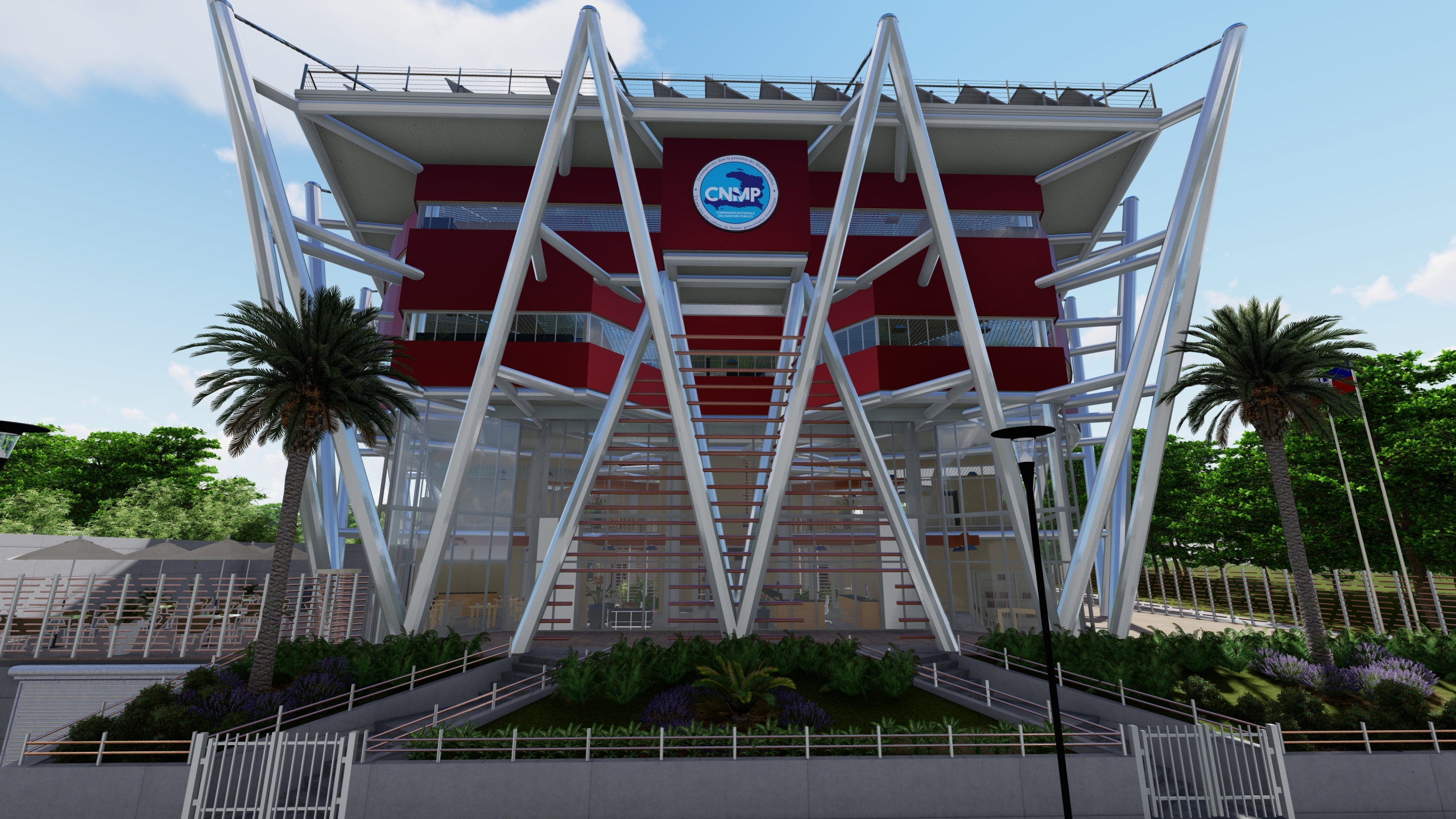
The architectural style chosen is close to the "techno-architecture" movement with the predominance of glass and metal, the transparency of the exterior envelope, and above all a staging of structural elements exposed in an ostentatious manner, accentuating its singular side, breaking with traditional forms.
The site is also accessible via Rue d'Ennery. The rear courtyard features 11 additional parking spaces, including two for people with reduced mobility. The caretaker's quarters are also located on this level, right next to the service staircase.
From the outside, what strikes you at first glance is the peripheral colonnade made of structural steel tubes, inclined outwards, reminiscent of an exoskeleton which responds to the desire to place the metal structure and the technical components at the center of the building concept.
The interior architecture is treated in such a way as to constantly manifest the higher intention of transparency, lightness and glorification of the load-bearing elements.
All the walls and doors opening onto the atrium are glazed, while the other partitions delimiting the offices are made of gypsum panels (Sheetrock).
Visitors walking through the building's premises can enjoy the spectacle of a star-shaped beam supporting each floor. This supporting structure of the floors is left exposed at the level of the central drum and remains visible through false ceilings with large meshes above the offices.
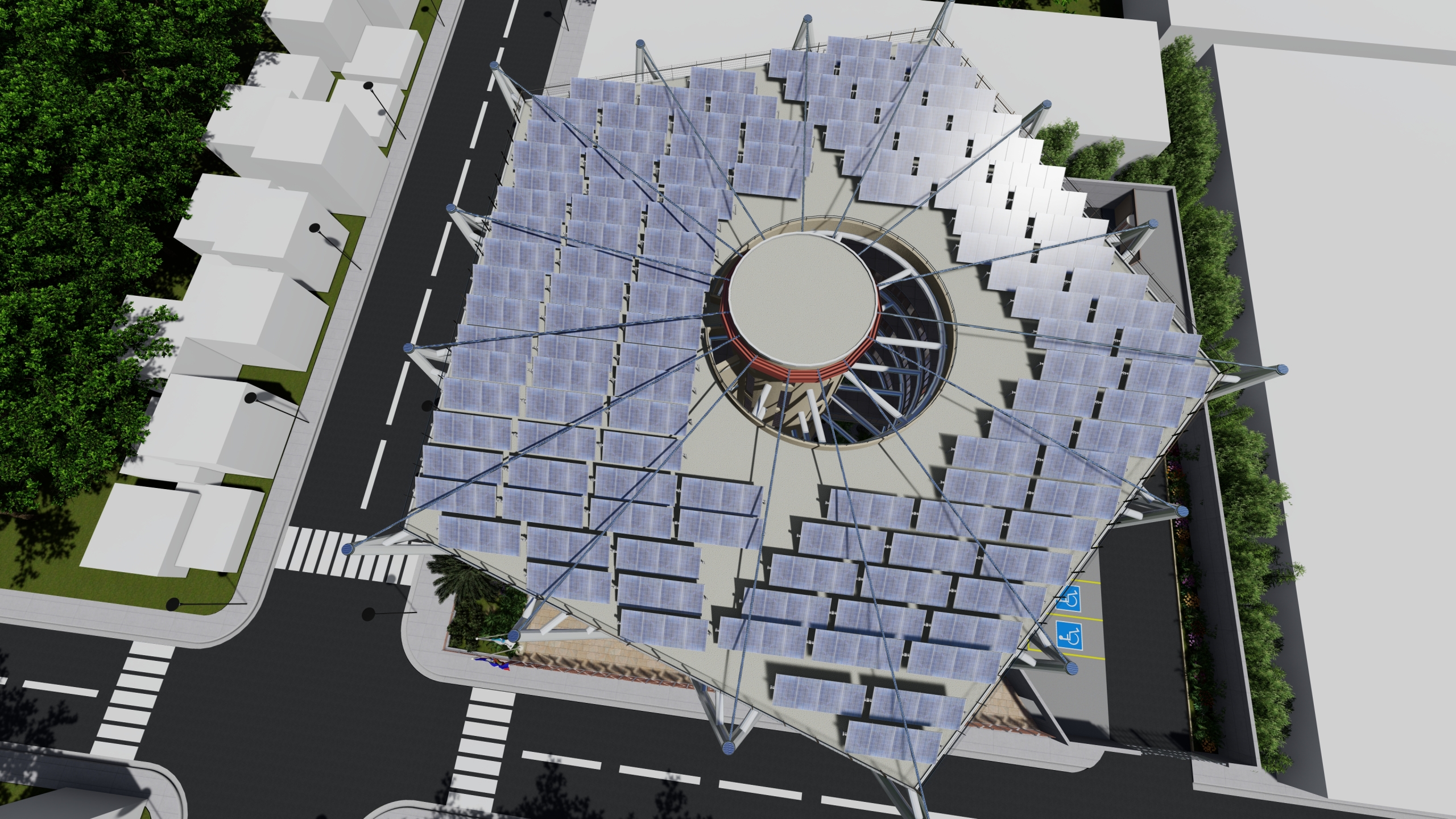
At the center of the building, a cylindrical tower made of reinforced concrete houses the main staircase and elevator. From the top of the latter, which protrudes slightly above the roof slab, stiffening cables radiate to the top of the facade columns.
The roof is treated as an accessible terrace to accommodate the solar panels necessary for the building's energy autonomy.
The central tower formed by the stairwell and elevator at the heart of the atrium takes on the appearance of a monumental drum from which radiate walkways and main beams that cross the void to support the surrounding floor slabs. This together constitutes the heart of the building, simultaneously serving as a circulation area, a light well, and an interior monument.


Leave A Comment